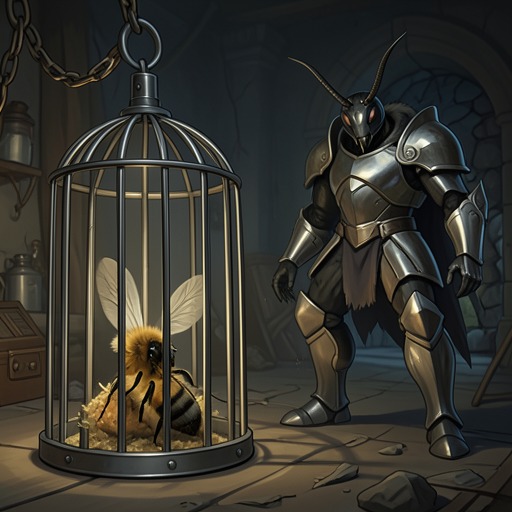
Maya’s captivity in the hornet fortress
The Adventures of Maya the BeeMaya’s captivity in the Hornet fortress is the turning point that transforms her isolation into responsibility for the Nation of Bees. Taken prisoner and confined within the fortress, she overhears the Hornets’ plan to attack at dawn. What begins as helpless confinement becomes a race to escape with the warning: Maya must carry what she has learned to her people before the planned assault can take them by surprise.
Capture and Conditions
Maya is seized by one of the Hornets and carried to the Hornet fortress. At first she cannot see her attacker clearly; she recognizes what has taken hold of her as a Hornet only after glimpsing its size and appearance. The capture leaves her overwhelmed, and she loses consciousness during the flight to the fortress. The sequence makes the change in her circumstances abrupt: she moves from danger in the open air to imprisonment among the enemy, with no opportunity to seek help or prepare.
When Maya regains her senses, she finds herself in a dim cell. A narrow crack admits a little light and lets voices from beyond the wall reach her. The Hornets’ walls are made of a dry, porous, grey material, unlike the wax walls of a bee dwelling. Looking through the small opening, Maya makes out remains of insects in the chamber, including bees. The room’s conditions make the threat of the fortress concrete without explaining exactly what will happen to her there; she fears she may not survive, and at first grief leaves her unable to act.
What Maya Learns
The crack in the wall offers Maya more than a glimpse outside her cell. Driven by fear, she edges close enough to see a large, illuminated hall where the Hornets have gathered in council. Captive glow-worms light the assembly, and the queen of the Hornets presides over it. Maya listens as the queen confirms the plan the council has arranged: one hour before dawn, the warriors are to attack the city of the Bees in the castle park. They are to plunder the hive and take as many prisoners as possible. Capturing Queen Helen VIII alive is singled out as a reward-worthy achievement.
The information gives Maya’s imprisonment its decisive stakes. She now knows that the danger extends beyond her own survival: her people are to be attacked while they sleep, and the queen is a specific target. Still confined, she cannot immediately warn anyone. Her response is grief for her country and her fellow Bees, coupled with the fear that the warning will never reach them. The knowledge makes her prison feel like a place from which she must act, not simply endure.
Resolve and Escape
Maya’s despair gives way to a deliberate resolve. She recalls her bond with her people and recognizes that the information she has overheard places a responsibility on her. Since she believes death may come whether she stays or attempts escape, she decides to use the chance she has to try to save the Bees. Her change is not a release from fear; it is a decision to act despite the danger.
After the watchman’s footsteps fade, Maya begins widening the crack in the brittle partition by biting away at it. The work takes time, and discovery could cost her life. Once the opening is large enough, she squeezes through into the hall. The fortress is quiet, and the distant entrance admits enough moonlight for her to make out a narrow passage leading out. She creeps along the walls and approaches the exit, only to find a sentinel standing in the doorway. His presence appears to close off her chance of escape, and Maya considers retreating.
Instead, she pauses to watch him. He is not attending to her but looking out at the moonlit landscape, and his still, reflective posture stirs her sympathy. The moment creates a contrast between his role as a guard in the Hornet fortress and the sadness Maya perceives in him. The evidence does not make him an ally in purpose: he remains a sentinel, and Maya is still a prisoner trying to get away. Yet she does leave the fortress. Once free to fly, she departs hurriedly, without pausing to thank him, because there is no time to spare.
From Captivity to Collective Defense
Maya’s escape carries the warning out of the fortress and back toward the community threatened by the attack. The following sequence turns from her solitary flight to the Bees’ preparations. The kingdom is in turmoil, but the mobilization is orderly: soldiers take their assigned places, scouts report that the Hornets are approaching, and the entrance is narrowed with two new wax partitions. The queen observes from an elevated position while the defenders wait for the enemy. This readiness stands in sharp contrast to the surprise attack the Hornet council intended.
When battle begins, the Bees’ collective defense exacts a severe cost. A young officer charges at the first opportunity and dies in the opening clash; his example intensifies the other soldiers’ willingness to fight. The Hornets have greater size and strength, and their attacks cause heavy losses, but the Bees defend the hive through coordinated ranks and fresh reserves. The account later identifies their unity and loyalty to their people as a source of strength. These events broaden the meaning of Maya’s escape: the warning matters because the Bees can turn knowledge into organized preparation, not because it removes the danger or cost of defending themselves.
Narrative Significance
The captivity joins a private ordeal to a collective crisis. Inside the cell, Maya’s immediate perspective is narrow: a small opening, a dark room, voices through a wall, and the fear of being unable to help. Through that opening, however, she discovers the plan that changes the meaning of her imprisonment. The fortress has confined her body but inadvertently placed her within hearing of information vital to the Nation of Bees.
Her response also marks a change in belonging. Though she has been away from home, the threat to her people makes her identify herself with them more strongly, and that renewed connection supplies the reason to risk escape. The passage therefore links courage not to fearlessness but to the decision to act while afraid. Maya’s departure is the hinge between captivity and warning; the organized defense that follows gives her escape consequences beyond her own survival.